- Where are the largest PGM deposits in the world?
- What are the primary uses and applications for palladium?
- What are the common properties of PGM metals?
- What are catalytic converters?
- How do the different engine types impact the use of palladium in catalytic converters?
- Why is demand for jewellery higher in China than any other region?
- What is the impact of the palladium ETFs?
- What are the price forecasts for palladium?
- What are the forecasts for global vehicle production?
- How do the Russian stockpiles affect the palladium market?
1. Where are the largest PGM deposits in the world?
The largest PGM deposits are found primarily in South Africa and Russia, while North America accounts for a lesser proportion of PGM output. South Africa is the primary producer of platinum with palladium as a by-product whereas Russia produces palladium as a by-product of nickel.
2. What are the primary uses and applications for palladium?
The manufacture of catalytic converters continues to be the primary use for palladium, with its consumption accounting for approximately 53% of estimated global demand in 2009. Other major sources include: electronics (15%), dental (11%), Chinese jewellery (10%) and other (11%). Other uses include chemical and petroleum catalysts, jewellery excluding China, and other minor uses of palladium.
3. What are the common properties of PGM metals?
Palladium is one of the six platinum group metals (PGMs), consisting of: platinum, palladium, osmium, ruthenium, iridium and rhodium. Of the six, palladium has the lowest melting point and is the least dense.
PGMs are known for their:
- Strength and durability
- Rarity
- Strong catalytic properties
- Resistance to oxidation and corrosion
- Conductivity and ductility
- High melting point
PGMs are most commonly used for technological advances in the fields of autocatalysts, power generation, alternative fuel sources, transportation, electronics and healthcare.
4. What are catalytic converters?
Catalytic converters are also commonly referred to as mufflers in cars. Simply put, they are small devices that are used to reduce the toxic emissions that result from an internal combustion engine by converting harmful pollutants into less harmful emissions.
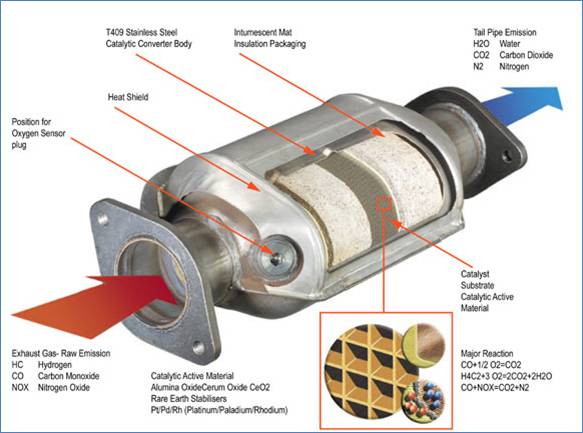
Source for image: Cateran Pty Ltd.
Click here for a video on how catalytic converters work: Catalytic Converter Deconstructed
5. How do the different engine types impact the use of palladium in catalytic converters?
- Gasoline engines: use more +90% palladium in catalytic converters.
- Diesel engines: historically used platinum due to technical requirements, however now use 25% palladium, with scope to increase to 50% due to advent of low sulphur diesel fuel.
- Hybrids & other new power forms: currently account for only 1% of global cars sales1 and are forecasted to be 14% of overall market by 20202 . Expected to have a neutral impact on PGM use as gasoline hybrids tend to use as much palladium as normal gasoline engines.
- Electric: forecasted to account for only 2% of global car sales by 20202; have no requirement for catalytic converters therefore would have a negative impact on PGM use. Given their current challenges (lack of infrastructure to recharge, high costs, long charging periods and short driving range), electric vehicles are not expected to be major threats to fabrication demand in the next decade.
1. CPM Group, June 2010
2. Stefan Bratzel, director of the Centre of Automotive Management in Germany; as reported in Mitsui Global Precious Metals “Pole Position” Report, June 2010
6. Why is demand for jewellery higher in China than any other region?
China remains the largest consumer of platinum and palladium jewellery. Palladium jewellery was introduced to China in 2004 in the form of Pd950 (95% palladium) and in 2005 in the higher purity Pd990 (almost pure palladium) opening up a brand new market. Its lower cost compared to platinum, has made it more accessible to consumers outside major Chinese urban centres. Most Chinese manufacturers now have the technical ability to work with palladium and combined with low palladium lease rates, benefit from the greater margins from the metal.
Given palladium’s strong resemblance to platinum (bright, white, tarnish-resistant), the metal is gaining more popularity in the jewellery market. As a matter of fact, as of January 2010, the UK legally recognized palladium as a precious metal and now require a statutory hallmark to be applied by an independent UK Assay Office if the palladium content weighs more than 1 gram.
7. What is the impact of the palladium ETFs?
Palladium exchange traded funds (ETFs), which have only been around since 2007, have significantly contributed to the increased investor interest in palladium. These ETFs are now trading in Zurich, London, Japan, and on the New York Exchange. Together, the ETFs’ holdings are approaching almost 2 million ounces of palladium in physical form and are expected to positively contribute to investment demand for the metal.
8. What are the price forecasts for palladium?
Most forecasters have a very optimistic outlook for the price of palladium and the general consensus is that palladium prices will continue to rise. A supporting factor behind the positive outlook for palladium’s future performance is the global supply and demand fundamentals: strong fabrication demand, increasing investment demand, and constrained supply.
9. What are the forecasts for global vehicle production?
Credible forecasters such as the CSM Worldwide predict that global light vehicle production will be in the range of 70 million units in 2010, rising to 93 million units by 2016. Vehicle sales are returning to their historical norms in mature economies, and are hitting new records in China, India and Brazil – the emerging economies that will lead the growth in the global automobile market.
10. How do the Russian stockpiles affect the palladium market?
There has been considerable speculation about the current holdings of the Russian government’s stockpiles that were accumulated in the 1970’s and 1980’s. While this remains to be a state secret, in the Summer and Fall of 2010, a number of public statements were made by credible forecasters indicating that the state stock have declined to relatively low levels and will not be a decisive factor in the palladium market going forward. If that proves to be true, based on Johnson Matthey’s data, without the Russian stockpiles the market would have been in a deficit of almost 1 million ounces in 2010. |


